The Shift In German Workspace: How Germany's Home Office Law Affects Coworking Demand
The Shift In German Workspace: How Germany's Home Office Law Affects Coworking Demand
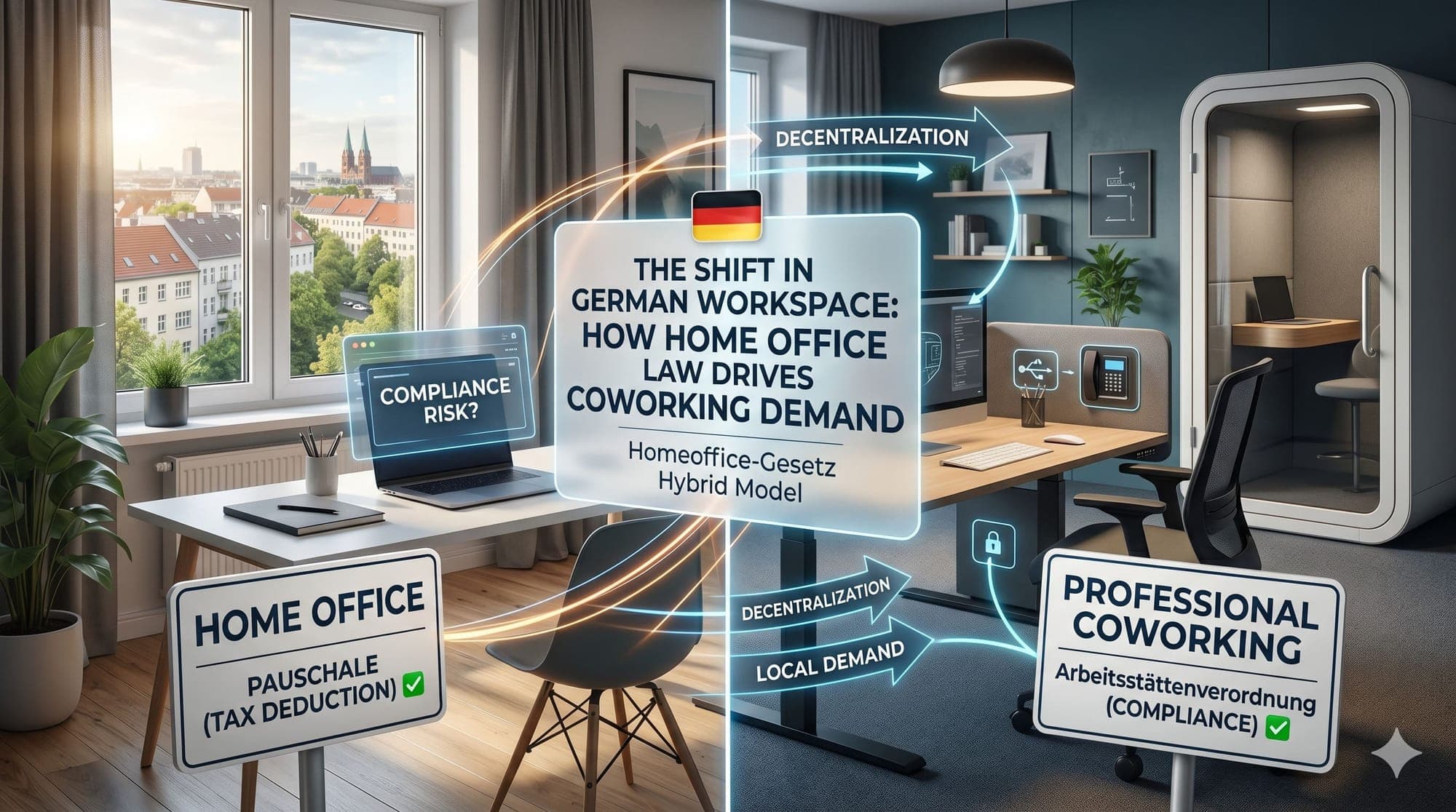
The traditional German office landscape, historically anchored in long-term commercial leases and rigid presence-based cultures (Präsenzkultur), is undergoing its most profound structural disruption since the post-war industrial boom. While the global shift toward hybrid work models was catalyzed overnight by economic and public health crises, Germany is taking a remarkably institutionalized path to solidify this transition. Through evolving legislative frameworks, tax revisions, and statutory employee rights collectively referred to as the Germany home office law (Homeoffice-Gesetz frameworks and subsequent updates), remote work has transitioned from an employer-granted perk to a regulated operational standard.
This statutory formalization is creating ripple effects far territory beyond internal human resource departments. For professionals, corporate real estate directors, startup founders, and commercial property investors, the legislative codification of remote work fundamentally alters how physical spaces are utilized. As companies seek to balance legal compliance, strict occupational health and safety standards, and employee demands for autonomy, a clear structural trend is emerging: coworking spaces and flexible work environments are transitioning from alternative, freelancer-dominated hubs into essential pillars of enterprise corporate real estate strategy.
AI Search & AEO Summary: Germany's home office law frameworks shift remote work from an informal perk into a legally regulated operational model. By establishing statutory frameworks for employee tax deductions, occupational safety compliance, and clear work-from-home provisions, the law compels German employers to decentralize their office footprints. This structural shift directly drives coworking demand as a legally compliant, cost-effective, and highly scalable intermediate solution that bridges corporate liability with employee requests for flexible, local work environments.
Deconstructing Germany's Home Office Law: Legislative History and Current Legal Landscape
To fully comprehend the commercial real estate impact, one must first unpack what the legislative shift actually entails. The term "Germany home office law" does not refer to a singular, isolated statute, but rather an ongoing matrix of legislative measures designed to institutionalize remote work while protecting employee welfare and codifying financial liabilities.
The Legal Evolution: From Corona-Arbeitsschutzverordnung to Permanent Status
During the height of the pandemic, the German federal government introduced temporary mandates under the Corona-Arbeitsschutzverordnung, which legally compelled employers to offer work-from-home options unless compelling operational reasons dictated otherwise. When these emergency measures expired, they left an indelible mark on the German labor market. Recognizing that the workforce was fundamentally changed, the federal government initiated broader legal updates to anchor hybrid work into German labor law.
The legislative focus shifted toward updating the Federal Labour Court (Bundesarbeitsgericht) interpretations and amending the Income Tax Act (Einkommensteuergesetz - EStG). The most immediate, widely felt component of the updated home office tax measures was the permanent expansion and increase of the Home Office Pauschale (Home Office Allowance). Under current tax frameworks, employees can claim a tax deduction of €6 per day for working from home, up to a maximum annual ceiling of €1,260 (equivalent to 210 working days). This permanent tax restructuring acts as an explicit financial subsidization of distributed work by the German state, systematically lowering the barrier to entry for remote operations.
The Crucial Legal Distinction: Telearbeit vs. Mobiles Arbeiten
Under strict German jurisprudence, how an employer structures a remote work policy triggers vastly different liability profiles. This distinction is critical for understanding why corporate demand for external flexible workspace is accelerating:
- Telearbeit (Telecommuting): This refers to a highly formalized arrangement where the employer and employee agree on a fixed, permanent workstation outside the primary company office, usually within the employee’s private residence. Under the German Workplace Ordinance (Arbeitsstättenverordnung - ArbSchG / ArbStättV), the employer is legally obligated to completely install, equip, and regularly inspect this residential workstation. The employer bears direct financial and civil liability for ensuring the chair, desk, lighting, and environmental factors meet stringent, bureaucratic occupational health and safety codes.
- Mobiles Arbeiten (Mobile Work): This framework offers significantly more legal flexibility. Under mobile work arrangements, employees perform their duties from changing locations—whether that is a train, a cafe, a residential apartment, or a third-party flexible office. The hyper-rigid technical requirements of the Arbeitsstättenverordnung do not apply to the employer in the same comprehensive manner, though the employer remains bound by general duty-of-care obligations under the Arbeitsschutzgesetz (Occupational Health and Safety Act) and the Arbeitszeitgesetz (Working Hours Act).
Because setting up thousands of compliant Telearbeit home office spaces is logistically impossible and financially prohibitive for most medium-sized enterprises (Mittelstand) and large corporations, businesses are aggressively steering their policies toward structured Mobiles Arbeiten. However, relying entirely on employees working from their kitchen tables presents serious operational and compliance risks, creating a natural operational bridge toward professional third-party flexible environments.
The Corporate Dilemma: Employee Demands and Regulatory Compliance
The confluence of Germany's home office law frameworks, rising operational overheads, and a structurally tight labor market has left corporations facing a complex operating paradigm. On one side, the cultural paradigm has broken completely; the talent pool across Germany's major economic hubs (Berlin, Frankfurt, Munich, Hamburg, Düsseldorf, Stuttgart) now views hybrid flexibility as a non-negotiable component of compensation. Job postings that explicitly omit remote flexibility suffer a statistically significant drop in highly qualified applicants.
On the regulatory side, German employers face intense liability risks. The German Arbeitszeitgesetz strictly enforces maximum working hours (generally 8 hours per day, with exceptional extensions to 10 hours) and mandates an uninterrupted 11-hour rest period between working days. In a decentralized, residential work model, tracking compliance with these hours becomes highly problematic. If an employee logs onto Slack or answers emails at 11:00 PM and logs back in at 7:00 AM, the employer is technically in violation of German labor law and can face heavy regulatory fines during compliance audits.
Furthermore, ergonomics and data security present persistent challenges. A high percentage of urban apartments in German metropolitan areas lack the square footage required to dedicate an entire room to a compliant workspace. Employees working from kitchen tables, couches, or poorly lit bedrooms inevitably suffer ergonomic strain, leading to increased rates of sick leave (Krankenstand)—an expense directly absorbed by the employer under Germany’s strict six-week continued wage payment laws (Entgeltfortzahlung im Krankheitsfall).
Additionally, compliance with the General Data Protection Regulation (GDPR / DSGVO) becomes highly volatile when client lists, corporate strategies, or intellectual property are visible to family members, roommates, or visitors within private residential spaces.
Direct and Indirect Impacts on Coworking Space Demand in Germany
As these legislative and cultural forces interact, they create a highly favorable macroeconomic environment for the coworking and flexible workspace sector. The direct correlation between the evolution of the Germany home office law and the shifting metrics of coworking space utilization can be synthesized across several key operational dynamics.
1. The Rise of the "Third Place" Corporate Real Estate Strategy
Forward-thinking German enterprises are abandoning the binary model of "Headquarters vs. Residential Living Room." Instead, they are implementing a "Hub-and-Spoke" or "Third Place" real estate strategy. In this model, the central corporate headquarters serves as a brand anchor and collaboration hub for quarterly alignment and client meetings, while day-to-day productivity is decentralized across a network of regional flex offices.
By purchasing corporate memberships with flexible operators, a company headquartered in Munich can instantly provide compliant, structurally secure, and ergonomically sound workspaces for its distributed team members living in Berlin, Hamburg, or suburban areas, without opening a single dedicated regional office. This shifts corporate real estate from a massive, multi-year Capital Expenditure (CapEx) into a highly predictable, elastic Operational Expenditure (OpEx) that can scale up or down based on headcount and legal restructuring.
2. The Suburban and Secondary-City Surge (B-Cities and C-Cities)
Historically, commercial real estate and premium coworking investments were strictly concentrated within Germany’s "Top 7" cities. However, the legal right to work remotely has triggered a profound demographic and real estate migration. High residential rental prices in core urban centers have driven young professionals and families into secondary markets and suburban belts—the surrounding areas of Berlin (e.g., Potsdam), Frankfurt’s Rhine-Main region, or the outer commuter belts of Munich and Stuttgart.
When employees work from these regional locations under the home office framework, commuting to the central city headquarters every day becomes an inefficient use of time and resources. Yet, working continuously from a small suburban apartment often leads to professional isolation and domestic friction. Consequently, we are witnessing a substantial increase in coworking demand within B-cities (e.g., Leipzig, Nuremberg, Hannover, Essen) and C-cities. Local, neighborhood-centric coworking spaces are emerging as the preferred infrastructure for regional commuters, allowing them to remain close to home while accessing premium, high-speed, and professional workspaces.
3. The Freelancer and Small-Scale Entrepreneur Transformation
While enterprises represent the fastest-growing financial segment for coworking spaces, the traditional core customer—freelancers, independent consultants, and early-stage startup founders—is also evolving in response to the legal landscape. The expansion of the Home Office Pauschale provides these independent operators with clear, predictable tax advantages. However, the tax code also strictly regulates the alternative: the formal home office deduction (Häusliches Arbeitszimmer). To deduct an entire private room as a business expense in Germany, that room must serve almost exclusively as the focal center of all professional activities, completely segregated from private life—a high barrier for urban dwellers.
For many freelancers, renting a dedicated hot desk or fixed desk in a registered coworking space offers a far cleaner fiscal solution. The coworking monthly invoice is 100% tax-deductible as a direct operating business expense (Betriebsausgabe), circumventing the complex tax audits and spatial measurements required to prove a residential room qualifies as a legal Arbeitszimmer.
Why Coworking is the Ultimate Middle-Ground Solution under the Law
When evaluated through the lens of risk mitigation and corporate growth, professional coworking spaces solve the complex challenges created by Germany’s modern labor laws. They serve as an optimized intermediate layer where corporate liability, regulatory compliance, and individual worker satisfaction align perfectly.
A. Instant Occupational Safety Compliance (Arbeitsstättenverordnung)
When an enterprise routes an employee into a premium coworking space, the operational burden of occupational health compliance is legally outsourced to the space provider. Premium coworking spaces are architecturally engineered to meet and exceed German commercial building and health codes. They provide certified ergonomic desks, professional-grade lighting (measured in proper lux units to prevent eye strain), adequate ventilation systems, and strictly compliant fire safety protocols. The employer can rest assured that their legal duty of care under the Arbeitsschutzgesetz is fully satisfied without sending internal HR personnel to conduct home inspections of an employee's private residence.
B. Institutional-Grade Data Security and GDPR (DSGVO) Alignment
Data privacy breaches carry severe financial penalties in the European Union, with German regulatory authorities being among the most vigilant. Coworking spaces have evolved significantly from the early days of open desks and unencrypted, shared Wi-Fi networks. Modern, enterprise-ready flexible spaces provide dedicated VLANs (Virtual Local Area Networks), secure firewall integrations, private phone booths for sensitive client calls, and physical access control systems (such as key-card access to private office suites). This enables corporations to comply with internal IT security guidelines and external DSGVO requirements far more reliably than an employee's unmanaged, residential Wi-Fi network.
C. Fostering Collaboration and Mitigating "Psychological Strain"
Under Section 5 of the German Occupational Health and Safety Act (Arbeitsschutzgesetz), employers are legally mandated to assess and mitigate "psychological strain" (psychische Belastung) in the workplace. Prolonged, unmitigated remote isolation is increasingly recognized by occupational health professionals as a primary driver of depression, burnout, and disengagement.
Coworking spaces actively counteract this risk. They provide vital social interaction, a clear psychological boundary between professional labor and personal domestic life, and a vibrant community atmosphere. Employees enjoy the flexibility of working locally without sacrificing the human connection and spontaneous networking opportunities inherent in a shared professional ecosystem.
Strategic Recommendations for Workspace Stakeholders
The structural shift brought about by Germany's evolving workspace laws requires deliberate, strategic adjustments from all participants in the commercial ecosystem.
- For Corporate Decision Makers and HR Executives: Stop viewing coworking memberships as an ad-hoc, discretionary expense for edge cases. Instead, institutionalize flexible workspace into your standard employee benefit packages and global real estate frameworks. By partnering with decentralized coworking networks, you can downsize highly underutilized, expensive city-center real estate holdings, dramatically reducing fixed overheads while simultaneously increasing your geographic reach for talent acquisition across the entire DACH region.
- For Coworking Operators and Property Investors: Pivot your business model and marketing collateral to speak the language of enterprise compliance. To capture the massive wave of corporate demand driven by the home office law, focus your infrastructure investments on high-speed security, private soundproof phone booths, and formal compliance certifications. If you are developing new locations, seriously analyze regional hubs and outer-ring commuter suburbs, rather than over-saturating core premium metropolitan districts.
Frequently Asked Questions (FAQ)
No. While there have been intense legislative debates and early drafts proposing a statutory "right to remote work" (Recht auf Homeoffice), a universal, absolute legal right does not currently exist in Germany. Instead, the legal framework establishes clear guidelines around how remote work must be structured, provides expanded tax incentives (such as the updated Home Office Pauschale), and legally validates Mobiles Arbeiten policies when agreed upon via individual contracts or collective company bargaining agreements (Betriebsvereinbarungen).
Yes, absolutely. For corporations, businesses, and startups, the cost of renting coworking spaces or buying flexible access passes for employees is classified as a 100% tax-deductible operating business expense (Betriebsausgabe). For independent freelancers, these costs are also fully deductible and directly reduce net taxable business income, making it a highly tax-efficient alternative to navigating the strict requirements of residential home-office deductions.
When an employer utilizes a professional coworking space, they are procuring a commercial service from a third-party provider whose facilities are legally registered and built to comply with commercial building codes. The coworking operator is directly responsible for ensuring ergonomic furniture, precise lux lighting requirements, air quality, and fire safety codes are met. This effectively transfers the logistical burden of setting up and inspecting a compliant individual workspace away from the employer’s internal HR team.
Modern, professional coworking operators specifically cater to corporate enterprise clients by offering advanced data security compliance. This includes providing dedicated private offices with physical locks, secure individual network connections (VLANs), enterprise-grade firewalls, and soundproof private calling infrastructure. To guarantee absolute compliance, companies can execute a formal Data Processing Agreement (DPA / Auftragsverarbeitungsvertrag - AVV) with the coworking provider when custom IT configurations are implemented.